Zoe Schröder · 2 September 2026
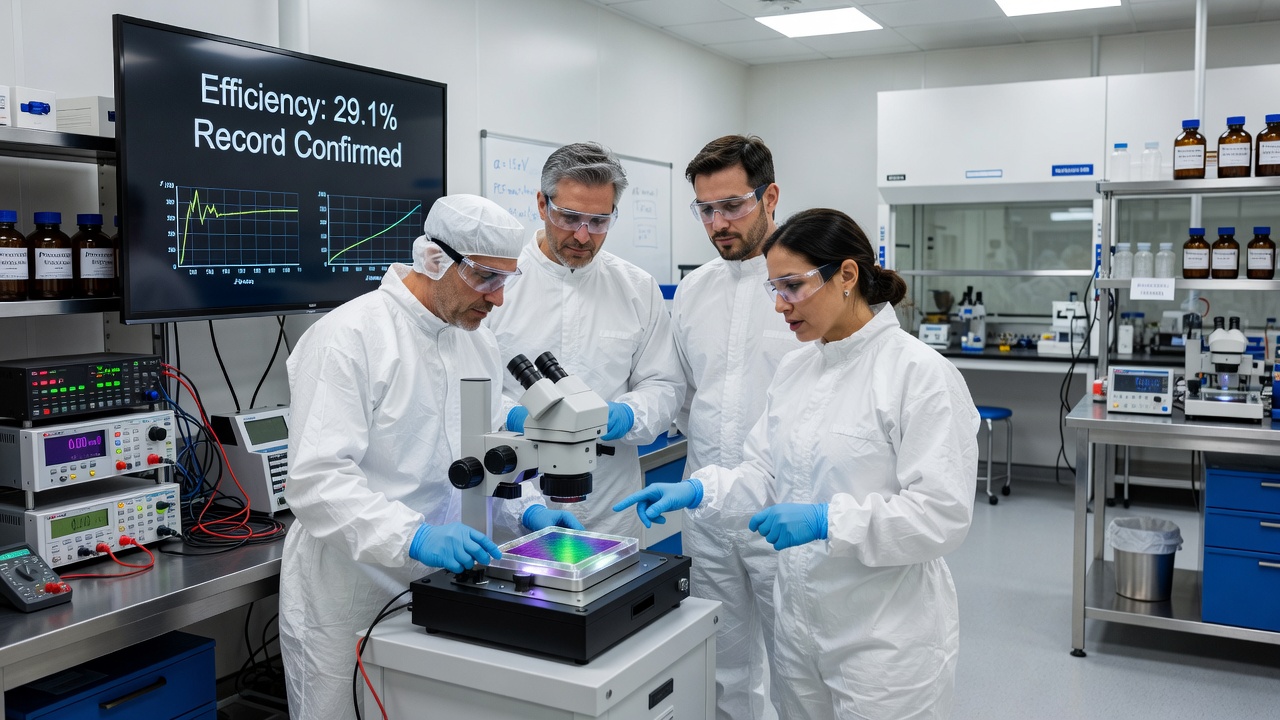
Novaforge Research and Innovation laboratory has reported a major advance in perovskite solar cell performance, achieving a certified power conversion efficiency of 28.7 percent under standard test conditions. The result surpasses the previous internal record by 1.9 percentage points and places the device among the highest-performing single-junction perovskite cells published to date.
Material and Process Innovations
Researchers stabilized the perovskite absorber layer through a dual-cation compositional tuning combined with a self-assembled monolayer interface that reduces defect density at the electron transport layer. X-ray diffraction and photoluminescence mapping confirmed improved crystallinity and suppressed non-radiative recombination. Accelerated aging tests at 85 degrees Celsius and 85 percent relative humidity showed less than 5 percent relative efficiency loss after 1,000 hours, addressing a key barrier to commercial deployment.
Device fabrication relied on a hybrid vapor-solution deposition sequence that enabled uniform films over 25 square centimeter substrates. External quantum efficiency measurements exceeded 90 percent between 450 and 750 nanometers, supporting the high short-circuit current density of 24.8 milliamperes per square centimeter. Independent verification was performed by a certified testing center using a solar simulator calibrated to ASTM G173 spectra.
Pathway to Module Integration
Scale-up trials on 10 by 10 centimeter minimodules yielded 24.1 percent efficiency with aperture area definition, indicating manageable losses during interconnection. Thermal and optical modeling suggests that further grid-line optimization could push module efficiency above 22 percent within two years. Novaforge is now collaborating with two European manufacturers to evaluate pilot-line compatibility and to assess bill-of-materials cost targets below 0.25 euros per watt.
The laboratory emphasizes that the new architecture remains compatible with tandem configurations, opening routes toward 35 percent efficient perovskite-silicon stacks. Continued work will focus on lead sequestration strategies and recycling protocols to meet forthcoming European regulatory requirements for photovoltaic products.