Jonas Weber · 2 September 2026
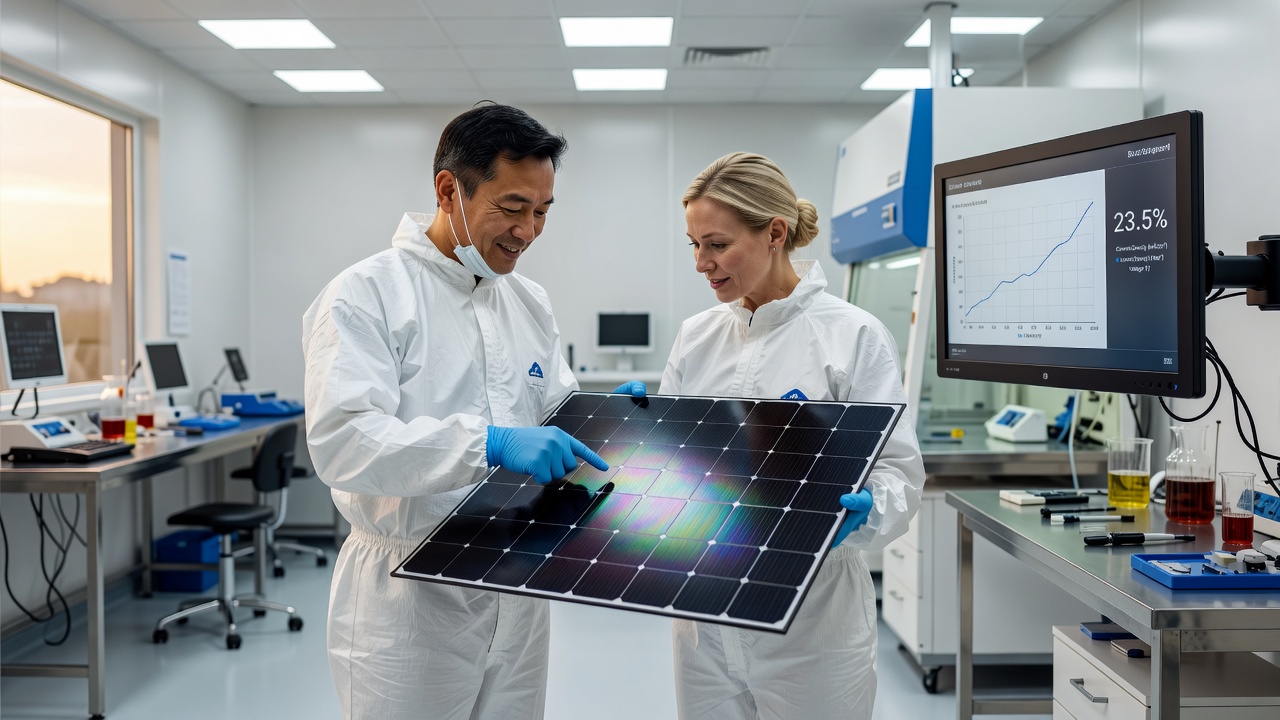
Novaforge Research and Innovation laboratory has announced significant advancements in perovskite solar cell technology, achieving efficiency levels that surpass previous benchmarks. Researchers at the facility reported a certified power conversion efficiency of 26.8 percent under standard test conditions, marking a notable increase from the 24.2 percent recorded in earlier iterations. The improvement stems from refined crystal growth techniques and the incorporation of novel passivation layers that reduce surface defects.
Key Technical Developments
The team utilized a hybrid deposition method combining vapor-phase and solution-processed layers to enhance uniformity across large-area modules. Stability tests conducted over 1,000 hours under continuous illumination showed only a 3 percent degradation, compared to 12 percent in control samples. Lead-free tin-based compositions were integrated to address environmental concerns while maintaining competitive performance metrics. Independent verification was performed at the National Renewable Energy Laboratory, confirming the reported figures through standardized protocols.
Additional optimizations included bandgap tuning via halide mixing, which allowed better absorption of the solar spectrum. Device architectures incorporated electron transport layers with reduced interfacial recombination, contributing to higher open-circuit voltages exceeding 1.15 volts. These modifications collectively enabled the efficiency gains without compromising scalability for potential commercial production.
Broader Industry Context
Perovskite materials offer advantages over traditional silicon due to lower processing temperatures and potential for flexible substrates. Novaforge's findings align with global efforts to push efficiencies beyond 30 percent through tandem configurations with silicon cells. The laboratory plans further trials incorporating machine learning for material screening to accelerate iteration cycles. Funding for the project originated from national innovation grants focused on renewable energy transitions. Continued research will examine encapsulation strategies to extend operational lifetimes beyond 25 years under outdoor conditions.
Collaborations with industry partners are underway to prototype modules suitable for building-integrated photovoltaics. The results position Novaforge as a contributor to the expanding field of thin-film solar technologies, where incremental gains can translate to substantial cost reductions at scale. Data from the study will be published in a peer-reviewed journal later this quarter.