Zoe Schröder · 23 September 2026
Student Entrepreneurs Advance Green Chemistry Through New Funding Rounds Aimed at Industrial Sustainability
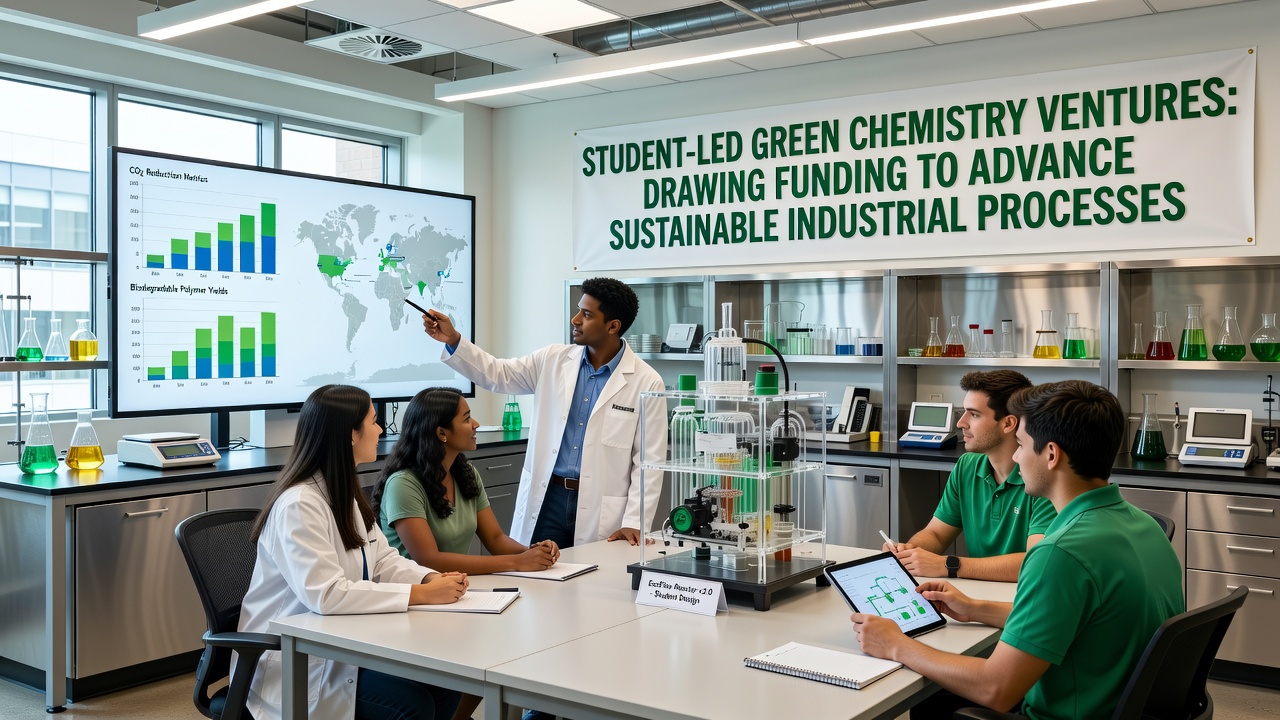
Student-led ventures focused on green chemistry principles continue to attract capital from both private investors and public agencies as they develop alternatives to traditional industrial methods that rely on hazardous solvents and high-energy inputs. These initiatives often originate in university laboratories where teams apply the twelve principles of green chemistry to create processes that minimize waste while maintaining product performance across sectors such as pharmaceuticals, textiles, and specialty chemicals.
Foundations of Student-Led Green Chemistry Efforts
Research programs at multiple institutions have trained undergraduates and graduates in catalysis design, bio-based feedstocks, and atom-economical reactions, and several of those programs now spin out companies that secure seed rounds within two years of formation. Data compiled by the American Chemical Society shows that green chemistry patents listing student inventors rose steadily between 2020 and 2025, with a notable cluster of filings related to enzymatic depolymerization of plastics and solvent-free coupling reactions.
Funding sources range from university technology-transfer offices to specialized climate-tech funds that evaluate both technical feasibility and scalability of proposed processes. In many cases, student founders retain academic affiliations while licensing core intellectual property back to their institutions, creating revenue streams that support further laboratory work.
Capital Inflows and Timeline Highlights
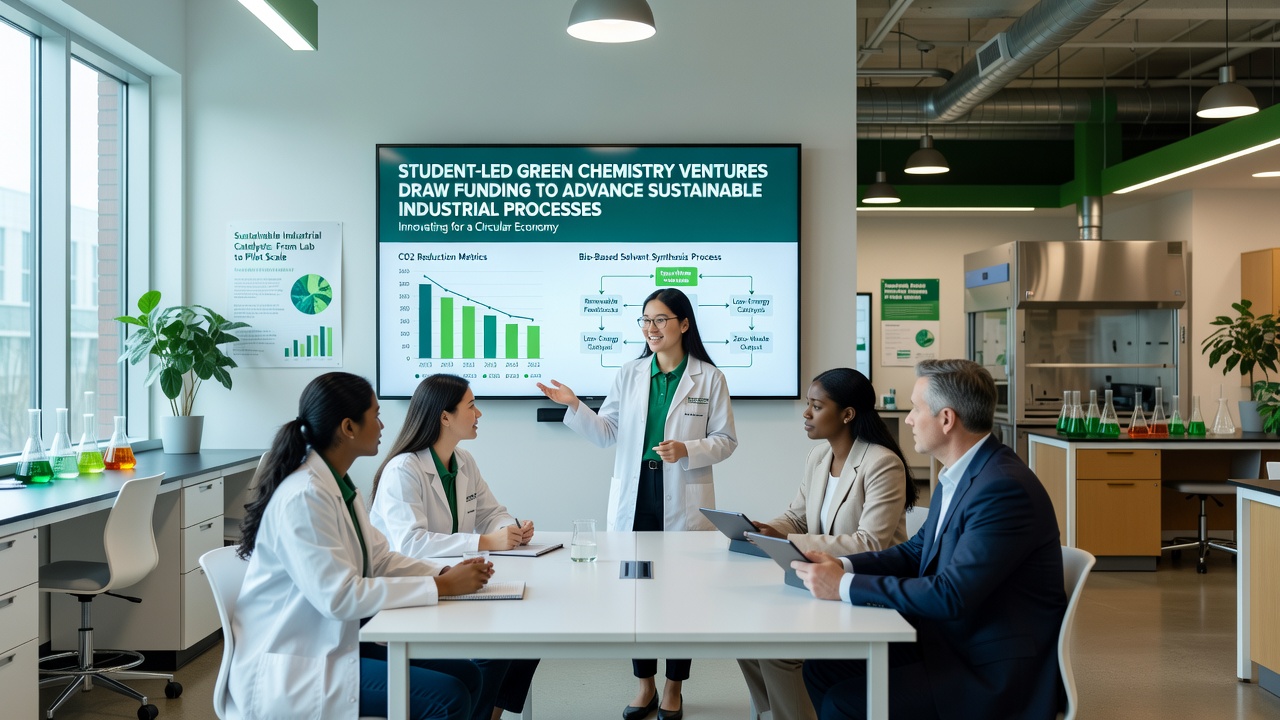
During September 2026, two separate student-founded companies closed Series A rounds exceeding eight million dollars each, according to filings with the U.S. Securities and Exchange Commission. One team commercialized a continuous-flow reactor that replaces batch nitration steps in pharmaceutical intermediate production, reducing energy consumption by approximately thirty-five percent. The second group advanced a lignin-derived dispersant for water treatment applications that substitutes for petroleum-based surfactants.
These deals followed earlier proof-of-concept grants from agencies such as the National Science Foundation and the European Innovation Council, which together provided non-dilutive capital exceeding four million euros across five projects in 2025. Observers note that the combination of academic validation and early regulatory alignment accelerates investor interest because it shortens the path from bench-scale demonstration to pilot-plant operation.
Process Innovations Reaching Industrial Partners
One venture based at a Canadian university developed a mechanochemical method for producing active pharmaceutical ingredients without organic solvents, and a contract manufacturer in Ontario has already integrated the approach into a commercial line. Another project originating in Australia focuses on enzymatic bleaching sequences for pulp and paper mills; pilot data indicate a reduction in chlorine dioxide usage by up to forty percent while preserving fiber strength metrics.
Industry organizations such as the U.S. Environmental Protection Agency have documented similar solvent-reduction strategies in their case-study library, providing third-party benchmarks that student teams reference when approaching potential licensees. Meanwhile, the European Commission environment portal lists comparable projects funded under the Horizon Europe cluster on climate-neutral industries, confirming that parallel efforts exist across regulatory jurisdictions.
Challenges in Scaling Laboratory Discoveries
Despite recent funding successes, student-led companies encounter recurring obstacles when moving from gram-scale synthesis to kilogram production. Reactor fouling, catalyst lifetime under continuous operation, and downstream purification requirements often demand engineering expertise that exceeds typical graduate training. Several teams have therefore formed advisory boards that include retired process chemists from major chemical firms to address these gaps before pilot-plant construction begins.
Supply-chain considerations also surface early because many bio-based reagents remain available only at laboratory quantities. Student founders report that securing multi-ton contracts with agricultural cooperatives or fermentation facilities requires longer lead times than anticipated, yet those agreements ultimately stabilize raw-material costs once established.
Conclusion
Student ventures operating at the intersection of green chemistry and industrial process design continue to secure both public grants and private equity as they demonstrate measurable improvements in energy efficiency, waste reduction, and regulatory compliance. The pattern established through 2026 suggests that sustained collaboration between academic laboratories, government agencies, and manufacturing partners will determine how quickly these innovations reach commercial scale across global supply chains.